
A larger camera sensor can collect more light, but it is only one part of the system that turns a phone camera into a useful tool. The choice matters when we take photos indoors, capture moving kids, or zoom in from the sidelines. A sensor can help with low-light performance, while resolution, lenses, aperture, stabilization, and software shape the final image.
Good image quality depends on how these parts work together. A high megapixel count may preserve fine detail, but it cannot make a weak lens sharp or steady a shaking hand. Optical zoom changes the lens or focal length, while digital or optical-quality zoom crops or processes the image. We can compare those trade-offs against the photography we do most, from portraits to wide travel scenes.
Start by matching the camera system to the scenes we photograph most often, rather than choosing by one headline specification.
Key Takeaways
- Sensor area affects how much light a camera can collect.
- Megapixel count describes image detail, not low-light results by itself.
- Lenses, aperture, stabilization, and software shape real photos.
- Compare each rear camera, not only the main sensor.
- Choose a phone for the scenes and zoom range we use most.
How Does a Phone Sensor Turn Light Into an Image?
Each pixel converts incoming photons into photoelectrons, giving the camera data it can turn into a photograph. A pixel is a light-sensitive element on an image sensor that converts incoming photons into an electrical signal. Megapixel count measures recorded picture elements, while physical sensor area and pixel layout affect light collection.
Pixels collect light through the camera lens, then send electrical signals for processing. Larger pixels have more surface area and can collect more photons, which can improve sensitivity, though that can mean lower resolution. Smaller pixels can record finer spatial detail, but each pixel captures fewer photons.
Photon collection, pixel size, and resolution
A sensor’s total light collection depends on its physical area and how that area is divided among pixels. A larger sensor can use more area for each pixel, while a high megapixel count can divide a sensor into many smaller pixels. Neither measure alone tells us how clear a finished image will look.
Pixel binning combines signals from neighboring pixels into a larger group. It can produce a lower-resolution image with stronger light information per output pixel. This is one reason a camera may offer both a full-resolution mode and a smaller default image.
So is a 64MP camera better than a 48MP camera? Neither resolution wins automatically. Sensor area, pixel design, lens quality, and processing all affect detail and low-light performance. A well-made 48MP camera can create a better image than a 64MP camera with weaker parts.
Treat megapixel count as a detail measure, not a stand-alone prediction of low-light performance.
How processing shapes the final image
Phone software can combine several frames to reduce visible noise, the grain or speckling that can show in dark areas. High dynamic range, or HDR, blends image data to keep bright highlights and dark shadows more balanced. Processing also affects color, sharpness, and contrast.
We can compare four practical factors when choosing a phone camera:
- Pixel size or binning options
- Megapixel count and image output
- Multi-frame processing and HDR
- Optical or digital stabilization
Stabilization helps reduce blur from hand movement, especially in dim scenes where the camera needs more time to capture light. It cannot freeze a subject that moves during the shot. The camera’s software also depends on the phone’s image signal processor, a dedicated unit that works on camera data.
Together, these details explain why two phones with similar sensor sizes can produce different results. We should judge samples in the kinds of light and scenes we actually photograph.
How Can We Judge Smartphone Camera Sensor Performance in Real-World Photos?
A useful camera comparison looks at the whole camera module, not just the main sensor’s megapixel count. Aperture, focal lengths, lens choice, stabilization, and software all shape mobile imaging. Each camera can behave differently, even within the same phone.
Compare the main, ultrawide, and telephoto cameras separately, since their sensor and lens combinations can differ substantially. The OPPO Find X9 Ultra shows why: its main camera has a 200MP sensor, a 23 mm focal length, a 1/1.12-type optical format, and an f/1.5 aperture.
Its 200MP portrait telephoto camera has a 70 mm focal length, a 1/1.28-type optical format, and an f/2.2 aperture. It can also focus as close as 15 cm for macro shots. The 50MP ultrawide uses a 14 mm focal length, a 1/1.95-type optical format, and an f/2.0 aperture.
Those figures describe different tools, not three versions of one camera. A lower f-number means a wider aperture, which lets more light through the lens. Focal length changes framing: a wide lens captures more of a scene, while a telephoto lens frames a distant subject more tightly.
Optical zoom comes from changing cameras or focal lengths. Digital zoom, also called optical-quality zoom on some phones, may crop and process an image instead. That can be useful, but it is not the same as adding a longer optical lens.
Software can combine frames, adjust exposure, and sharpen details. Stabilization can limit blur from hand movement, while subject movement may still soften a shot. A nearby subject with space behind it can also create natural background blur, rather than relying only on portrait-mode effects.
We can use a camera hardware comparison to see how sensor area, pixel binning, lenses, and focal lengths vary across phone cameras. For a broader view of the processing hardware, our guide to mobile processor architecture explains how dedicated image processing fits into the phone.
Check sample images at the focal lengths we use most, since a strong main camera cannot guarantee equally strong zoom or ultrawide shots.
Which Smartphone Phones Have the Largest Camera Sensors?
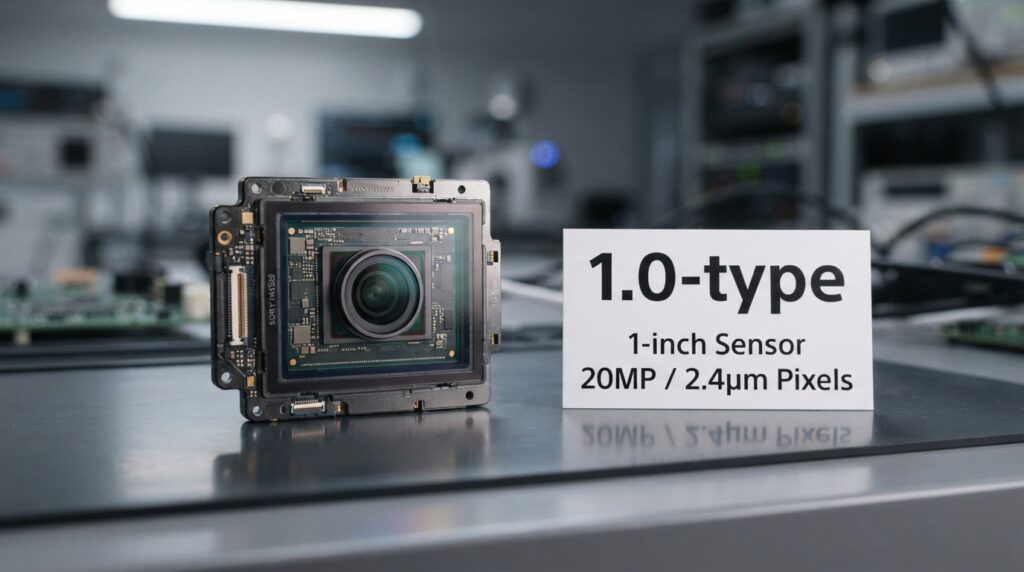
The largest phone-camera sensor category established in the supplied examples is 1.0-type, not a physically one-inch-wide chip. As of February 2024, no smartphone used a primary camera sensor larger than 1.0-type. That category remains a useful marker, but its label describes optical format rather than a literal measurement across the sensor.
The Sony IMX989 and LYT-900 sensors measure 13.1 × 9.8 mm. A smartphone camera sensor list, or smartphone camera sensor size list, should name the optical format and megapixel count. The largest camera sensor in a mobile phone in these examples belongs to the 1.0-type category.
What 1.0-type means in a phone camera
“1.0-type” is a traditional optical-format label. It does not mean the sensor measures exactly one inch across. The label helps us compare sensor sizes, but it is not the sensor’s direct width or diagonal.
The Panasonic Lumix CM1 became the first camera phone with a 1.0-type sensor in 2014. Seven years passed before another phone used one. Leica’s Leitz Phone 1 followed in 2021, and Sony introduced the IMX989 in 2022.
From 2022 onward, the 1.0-type phone examples use the IMX989 or LYT-900. That history gives context for why the format remains a notable feature on flagship phones.
Current phone examples with 1.0-type main sensors
These phones list a 1.0-type primary camera sensor and a 50MP primary camera resolution:
| Phone | Primary sensor format | Primary camera resolution |
|---|---|---|
| Huawei Pura 80 Ultra | 1.0-type | 50 MP |
| OPPO Find X8 Ultra | 1.0-type | 50 MP |
| Xiaomi 17 Ultra | 1.0-type | 50 MP |
| Sharp Aquos R9 Pro | 1.0-type | 50 MP |
The Huawei Pura 80 Ultra lists a 23 mm-equivalent focal length and an f/1.6 aperture for its primary camera. The Xiaomi 17 Ultra lists a 23 mm-equivalent focal length and an f/1.7 aperture. Those lens details add context, but they do not change the sensor-format label.
Check the date attached to any claim about a “largest” sensor, because phone models and sensor formats can change.
Which Camera Phones Perform Best for Different Buyers?
A phone’s strongest measured score is useful only when we know what the test measures and whether its result matches our priorities. CNET named the iPhone 18 Pro its best all-round camera phone in 2026 and picked the Samsung Galaxy S26 Ultra for Android buyers. Those picks reflect one test’s approach, not a universal ranking.
Use scores to narrow a shortlist, then choose by the photos, zoom, and controls we need. In 2026, CNET gave the iPhone 18 Pro and Samsung Galaxy S26 Ultra scores of 9.3. Its Google Pixel 11 Pro and 11 Pro XL, and Nothing Phone 4A Pro, each scored 8.0.
What camera tests and ratings can tell us
Here are CNET’s listed US prices from 2026, alongside its camera-phone scores:
| Phone | CNET camera-phone score | Listed US price in 2026 |
|---|---|---|
| iPhone 18 Pro | 9.3 | $1,199 |
| Samsung Galaxy S26 Ultra | 9.3 | $1,300 |
| Google Pixel 11 Pro and 11 Pro XL | 8.0 | $1,299 |
| Nothing Phone 4A Pro | 8.0 | $600 |
CNET lists the iPhone 18 Pro’s rear cameras as 48MP wide, 48MP ultrawide, and 48MP telephoto. The Samsung Galaxy S26 Ultra has a 200MP main camera, plus 3x and 5x optical zoom. Its 2x and 10x optical-quality zoom uses cropping and processing instead.
DXOMARK scores combine photo, zoom, and video tests. Its versions 5 and 6 are not directly comparable, and rankings can change. In 2026, DXOMARK gave the Huawei Pura 80 Ultra a Camera score of 175, a photography score of 180, and a main-camera score of 184. Its 2026 camera test scores also gave the OPPO Find X9 Ultra 170 overall and 173 for telephoto.
The Google Pixel 11 Pro XL scored 168 before Video Boost processing and 175 after it. DXOMARK gave the vivo X300 Ultra 170, iPhone 17 Pro Max 168, Xiaomi 17 Ultra 166, and Samsung Galaxy S26 Ultra 157. The tested iPhone 17 Pro shares its rear camera hardware with the Pro Max.
Other 2026 DXOMARK scores include 172 for iPhone 18 Pro, 168 for Pixel 11 Pro XL, 154 for Pixel 11, 157 for iPhone 17, and 146 for Samsung Galaxy S26. OPPO Find X9 Pro scored 166, Xiaomi 17 Pro Max 159, Xiaomi 15T Pro 149, Motorola Signature 164, vivo X300 Pro 171, Motorola Razr Fold 164, Tecno Camon 50 Ultra 5G 146, and Google Pixel 10a 134.
These results show why we should keep each test protocol in view. CNET’s everyday photography recommendations include iPhone 17 and 18 Pro models, plus Samsung S25 and S26 Ultra phones. It names Xiaomi 15 Ultra and Xiaomi 17 Ultra as high-end options for experienced photographers.
The Samsung Galaxy S26 Ultra camera details support a long reach, but the optical and optical-quality zoom labels describe different methods. A camera buying guide also explains how field of view affects scene coverage, though home cameras serve a different job.
Picks for everyday use, Android, and enthusiast photography
We can match these choices to common needs:
- iPhone 18 Pro for CNET’s all-round camera pick.
- Samsung Galaxy S26 Ultra for Android fans and a broad zoom range.
- Xiaomi 15 Ultra or Xiaomi 17 Ultra for experienced photographers.
- iPhone 17 or Pixel 10 for less complicated everyday use.
The iPhone 17 offers a 48MP ultrawide camera and 24MP default image output. The Pixel 10 has a 48MP main camera, 13MP ultrawide, and 10.8MP telephoto with 5x optical zoom. The OnePlus 15 uses three 50MP cameras.
For a top-ten shortlist, we can compare tested contenders without claiming one cross-protocol order:
- Huawei Pura 80 Ultra
- OPPO Find X9 Ultra
- vivo X300 Ultra
- Google Pixel 11 Pro XL
- iPhone 17 Pro Max
- Xiaomi 17 Ultra
- Samsung Galaxy S26 Ultra
- iPhone 18 Pro
- OPPO Find X9 Pro
- vivo X300 Pro
For older adults, we should favor familiar controls, readable settings, and reliable accessibility features over sensor size. Before buying, compare the camera modes we will actually use and check that the chosen phone’s controls feel comfortable in hand.
Test scores describe a phone under a particular method; they do not prove it will suit every photographer.
Conclusion
The best camera phone for us is the one whose full camera system suits the scenes we take most often. Sensor size matters, but it cannot stand in for the lens, software, stabilization, and zoom range we use. Our choice should fit the photos we want, not just the largest number on a spec sheet.
We can make the decision more practical by testing cameras in familiar settings. Before replacing a phone, compare a few sample photos in the lighting and focal lengths we use every day.