Did you know the United States debt market is much larger than the entire stock market? Many people buy shares, but savvy investors use Corporate Bonds to build wealth. When you buy these instruments, you lend money to a company for a set period.
Unlike stockholders, you do not own part of the business. Instead, you receive regular interest payments for your loan. You should understand how bond yields, credit quality, and maturity dates affect your total return.
Safety is a major factor for many investors. If a company faces financial trouble, debt holders typically have a higher claim on assets than shareholders. However, your money is not risk-free, so we will explore ways to balance these risks in the fixed-income market.
Key Takeaways
- Lending money to firms provides a predictable income stream through interest.
- You do not own a piece of the company when you hold debt instruments.
- Credit ratings help you assess the likelihood of receiving your principal back.
- Debt holders often have priority over stockholders during bankruptcy proceedings.
- Maturity dates dictate when the issuer must return your original investment.
What Are Corporate Bonds?
Corporate debt securities can form a key part of a diversified investment portfolio. They let companies borrow from individual and institutional investors to fund operations, research, or expansion projects.
Definition and Overview
When you buy a bond, you become a lender to the company. In return, the business promises to repay the principal on a set future date. You usually receive regular interest payments, often called coupon payments.
These securities come from many entities, including small regional firms and massive global conglomerates. Because these corporate bond issuers have different financial strength, each bond carries a different level of risk and reward.
How Corporate Bonds Work
Every bond includes an offering document that explains the loan terms. It states the amount borrowed, interest rate, and maturity date. The maturity date is when the company must return your original investment.
Investors often choose a maturity length based on their financial goals:
- Short-term bonds: Usually mature in one to three years, offering lower interest rates but less exposure to market volatility.
- Medium-term bonds: Typically range from four to ten years, providing a balance between income and risk.
- Long-term bonds: Often exceed ten years, which may offer higher yields to compensate for the increased uncertainty over time.
Different Types of Corporate Bonds
Bonds do not all use the same structure. Learning about different corporate bond issuers and their offerings helps you match investments to your risk tolerance.
Here are the most common structures you might encounter:
- Fixed-rate bonds: These pay a set interest rate for the entire life of the bond, providing predictable income.
- Floating-rate bonds: The interest payments on these bonds adjust periodically based on a benchmark rate, such as the prime rate.
- Zero-coupon bonds: These do not pay regular interest. Instead, they are sold at a deep discount to their face value and pay the full amount at maturity.
By choosing the right corporate debt securities, you can build a strategy for your income needs. Always review the prospectus carefully to understand each bond’s unique terms.
Benefits of Investing in Corporate Bonds
Adding corporate bonds to a strategy can provide a useful mix of stability and growth potential. Adding investment-grade bonds can improve your plan’s overall quality. These assets support many fixed income investments by balancing risk and reward.
Steady Income Stream
We favor these securities because their payouts are predictable. Issuers usually make scheduled coupon payments, helping you plan cash flow with confidence.
The actual yield depends on the coupon rate and current market prices. Yet these payments remain reliable for income-focused investors. Consistency often helps investors meet long-term financial goals.
Portfolio Diversification
Corporate bonds provide access to many economic sectors, including technology and utilities. This variety can reduce the effect of volatility affecting individual industries.
Holding these assets with equities or government securities creates a more balanced portfolio. Consider these benefits for your asset allocation:
- Reduced correlation with stock market swings.
- Access to diverse corporate revenue streams.
- Enhanced stability during periods of market uncertainty.
Capital Preservation
We see capital preservation as a main goal when choosing high-quality debt instruments. No investment is free of risk, but investment-grade bonds usually come from companies with strong balance sheets.
Bond values can change when interest rates change. Issuers can also default, so careful research matters for all fixed income investments. Treat preservation as a goal, not a guaranteed result.
Risks Associated with Corporate Bonds
Navigating the bond market means balancing income goals against possible financial losses. These securities often seem safer than stocks, but specific risks can reduce your total return. Careful review can help protect your capital over the long term.
Credit Risk
Credit risk means an issuer may miss scheduled interest or principal payments. This matters when considering high-yield bonds, issued by companies with lower credit ratings. These investments offer higher payouts to offset their greater default risk.
“Risk comes from not knowing what you are doing.”
Interest Rate Risk
When market interest rates rise, existing bond prices typically fall. This inverse relationship is central to interest rate risk. Longer-duration securities react more to these changes, causing greater price swings in the bond market.
Inflation Risk
Inflation quietly reduces the buying power of future coupon payments. If inflation exceeds your investment’s yield, your real return becomes negative. This risk is stronger for long-maturity high-yield bonds, because future dollars lose value over time.
| Risk Type | Primary Driver | Impact on Price |
|---|---|---|
| Credit Risk | Issuer Financial Health | High (Default Potential) |
| Interest Rate Risk | Market Rate Changes | Moderate to High |
| Inflation Risk | Consumer Price Index | Low (Purchasing Power) |
How to Invest in Corporate Bonds
Building a portfolio of debt securities can take several paths. Beginners and experienced investors should learn how to access Corporate Bonds. This knowledge is the first step toward meeting financial goals.
Direct Purchase Options
Many investors buy individual securities through brokerage accounts. These Corporate Bonds usually come in $1,000 face value blocks. The purchase may include commissions or dealer markups.
These costs can reduce your overall yield, so review your brokerage firm’s pricing structure. Direct buying lets you hold the asset until maturity. It can provide predictable interest payments.
Bond Funds and ETFs
For a hands-off approach, bond funds and exchange-traded funds (ETFs) offer a convenient choice. These vehicles provide instant diversification across hundreds of different issuers and sectors. Pooling your money reduces the impact of one company defaulting on its debt.
These funds have management expenses that can lower your net returns. Unlike individual holdings, an ETF’s market price changes daily with supply and demand. Consider this market-price risk before investing.
Working with Financial Advisors
A professional can help match your portfolio to your needs. Discuss your time horizon, liquidity requirements, and risk tolerance with an advisor. Review bond ratings to match debt quality with your comfort level.
Your advisor can also explain your investments’ complex tax effects. They can compare taxable and tax-exempt options for your current financial situation. This guidance helps keep your strategy strong over the long term.
| Investment Method | Primary Benefit | Key Consideration |
|---|---|---|
| Direct Purchase | Predictable Income | Transaction Costs |
| Bond Funds/ETFs | Broad Diversification | Management Fees |
| Financial Advisor | Expert Strategy | Bond ratings analysis |
Key Factors Impacting Corporate Bond Prices
Several forces shape debt security values in the open market. A bond’s market price and its bond yields often move in opposite directions. This relationship explains why prices change each day.
Economic Indicators
Broad economic data strongly influences the fixed-income market. When inflation rises, central banks often raise interest rates to cool the economy. This usually lowers existing bond prices because investors seek higher returns against weaker purchasing power.
When growth slows, interest rates may stabilize or decline. Existing bonds with higher coupons then look more attractive to buyers. As demand grows, these securities usually gain market value.
Company Performance
The financial health of corporate bond issuers helps keep bond prices stable. Strong cash flow and manageable debt reassure investors about receiving interest payments. That confidence supports the bond’s market value.
Declining revenue or excessive debt can increase a company’s perceived risk. Investors may question whether the issuer can meet its obligations. As default risk rises, the bond’s price often falls.
Market Sentiment
Investor psychology strongly affects debt prices on the secondary market. During market stress, investors often choose safer assets, causing corporate debt prices to fall. We measure this risk through credit spreads, the extra yield investors demand over government bonds.
When sentiment is positive, these spreads often narrow as investors accept more risk. When fear dominates, spreads widen because investors demand a larger premium for corporate debt. Watching these trends helps investors manage a successful portfolio.
| Factor | Impact on Price | Primary Driver |
|---|---|---|
| Rising Interest Rates | Decrease | Central Bank Policy |
| Improved Credit Rating | Increase | Company Fundamentals |
| Market Panic | Decrease | Investor Sentiment |
| Economic Expansion | Increase | Corporate Earnings |
Understanding Bond Ratings
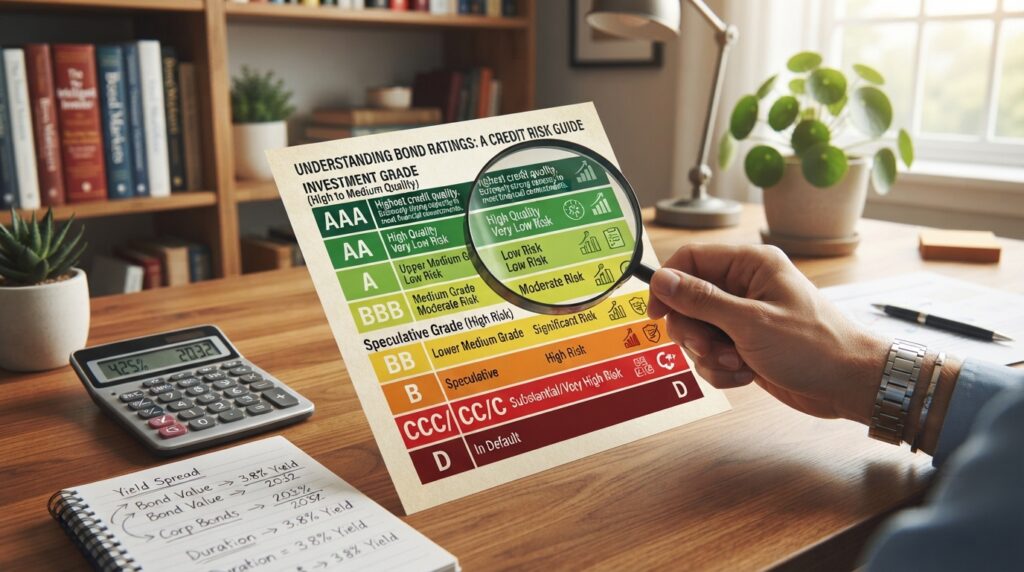
Bond ratings guide investors through the complex world of corporate debt. These scores offer a standard way to judge whether an issuer can pay interest and principal on time. They help us manage risk when we build a fixed-income portfolio.
Importance of Bond Ratings
The main purpose of these evaluations is to measure the chance of default. When a company issues debt, experts review its financial health, cash flow, and market position. High ratings show strong payment ability, while lower scores point to greater financial distress.
These measures help us separate stable, established firms from firms in more volatile positions. Using bond ratings, we see the safety profile of potential holdings more clearly.
Major Rating Agencies
Three main organizations lead credit analysis: Moody’s, Standard & Poor’s, and Fitch. Each agency uses its own scale, but all aim to promote transparency. Letter-based systems are common, including AAA for the highest quality and D for bonds in default.
These agencies may sometimes disagree about a company’s creditworthiness. This creates split ratings, when one agency views a bond more favorably than another. We should compare the consensus among these firms before making an informed choice.
How Ratings Affect Investment Decisions
The difference between investment-grade bonds and speculative-grade securities is central to portfolio strategy. Investment-grade securities usually have lower perceived default risk, so conservative investors often choose them. Speculative-grade bonds often offer higher yields for the greater risk of non-payment.
We also watch credit migrations, including upgrades and downgrades. A “fallen angel” occurs when a bond is downgraded from investment-grade to speculative status, often causing major price volatility.
Conversely, a “rising star” is a company that improves its credit profile, often causing price appreciation. Tracking these shifts lets us adjust our holdings proactively.
Corporate Bond Market in the US
The United States corporate bond market supports economic growth and business expansion. Companies use debt to fund capital projects, refinance obligations, and pursue strategic acquisitions. Issuing debt lets firms distribute capital to shareholders while keeping operations moving.
Overview of the Current Market
The current bond market includes issuers from nearly every economic sector. Investors can choose credit qualities, maturities, and yields that match their financial goals. This range gives conservative and aggressive investors choices that fit their risk tolerance.
A large market still carries serious risks. Investors must watch issuer health, liquidity limits, and possible interest-rate changes. Careful analysis remains central to successful participation.
Trends and Growth Potential
Corporations are changing how they meet financing needs. Many firms now choose flexible debt structures to handle changing economic conditions. This shift creates growth potential for people who understand corporate credit.
The table below shows key differences among common debt categories in today’s market:
| Feature | Investment-Grade | High-Yield Bonds |
|---|---|---|
| Credit Rating | Higher (BBB- or above) | Lower (BB+ or below) |
| Default Risk | Lower | Higher |
| Yield Potential | Moderate | Attractive/Higher |
| Primary Goal | Capital Preservation | Income Generation |
Key Players in the Corporate Bond Market
The market includes large institutions and specialized firms. Large corporations often issue high-yield bonds to fund aggressive expansion or restructuring. Stable blue-chip companies usually offer investment-grade debt to protect their credit standing.
Financial intermediaries and rating agencies help keep the market transparent. Their standard assessments help investors compare different levels of risk. Knowing these roles supports informed decisions in a changing financial environment.
Tax Considerations for Corporate Bond Investors
When you invest in corporate debt securities, tax rules matter as much as choosing the right assets. Taxes can greatly reduce returns from your fixed income investments if you do not plan carefully. Look beyond the yield and consider how your tax bracket affects your final profit.

Taxable vs. Tax-Exempt
Most interest from corporate bonds is taxable at both federal and state levels. Municipal bonds often provide interest exempt from federal income tax. When comparing them, calculate the tax-equivalent yield to see which investment leaves you with more money.
“The art of investing is not just about what you earn, but what you keep after the tax man takes his share.”
| Bond Type | Federal Tax | State Tax |
|---|---|---|
| Corporate Bonds | Taxable | Taxable |
| US Treasuries | Taxable | Exempt |
| Municipal Bonds | Often Exempt | Often Exempt |
Understanding Capital Gains Taxes
If you sell bonds before maturity, you might trigger a capital gain or loss. A gain occurs when you sell a bond for more than its adjusted cost basis. Selling for less creates a capital loss, which may offset other investment gains.
Track your purchase price and any accrued interest paid when you buy the bond. These figures help you calculate your tax liability accurately. Always keep detailed records of your transactions to simplify tax reporting.
Reporting Bond Income
You will usually receive Form 1099-INT from your brokerage to report interest income. However, zero-coupon bonds need special attention because they create “phantom income.” Although you receive no annual cash payments, the IRS taxes prorated interest as it accrues.
Confirm current federal and state treatment with a qualified tax professional. Tax laws change often, and a professional can help with your specific financial situation. Proper planning helps your fixed income investments remain a reliable part of your long-term wealth strategy.
Strategies for Managing Corporate Bonds
A bond portfolio’s success often depends on the investor’s management strategy. Your approach to Corporate Bonds shapes your experience in the fixed-income market, whether you seek steady income or capital preservation.
Buy and Hold Strategy
Conservative investors often favor the classic buy and hold approach. Buying high-quality debt securities and holding them until maturity can lock in expected bond yields. This strategy limits daily market stress and significantly reduces transaction costs.
Holding these assets until maturity can return your principal, provided the issuer remains solvent. This approach offers a simple way to build predictable income for your financial future. For deeper analysis, resources like Managing Corporate Portfolio offer useful insights into this discipline.
Laddering Technique
Laddering manages interest rate risk by spreading maturity dates across different time horizons. Buying Corporate Bonds with staggered maturity dates avoids reinvesting all your capital at one potentially unfavorable interest rate.
This technique provides steady liquidity because part of your portfolio matures regularly. When market conditions change, you can reinvest proceeds from maturing bonds into new issues reflecting current market realities. It helps maintain balance in a volatile economic environment.
Timing the Market
Timing the market means buying and selling based on predicted interest rate movements or credit spread shifts. This approach can produce capital gains but carries major risks, especially before maturity. Changes in liquidity or credit quality can cause unexpected losses.
Investors should also watch callable bonds, which let issuers return your principal early. This feature can limit future coupon payments when rates fall. Always weigh higher return potential against the risk of losing expected income.
| Strategy | Primary Goal | Risk Level | Complexity |
|---|---|---|---|
| Buy and Hold | Steady Income | Low | Minimal |
| Laddering | Risk Mitigation | Moderate | Moderate |
| Market Timing | Capital Gains | High | Advanced |
Conclusion and Key Takeaways
A resilient portfolio requires understanding how market forces affect returns. Credit quality, maturity, and interest rates drive results in corporate debt markets.
Synthesizing Market Essentials
Treat bond ratings as signs of credit health, not guarantees of repayment. These scores help you identify investment-grade bonds, but they cannot shield your entire portfolio from unexpected market shifts. Your position in the capital structure matters: secured, senior unsecured, and junior unsecured bonds offer different levels of protection if an issuer faces bankruptcy.
Strategic Investor Mindset
Balance your tax situation with your liquidity needs. Diversification remains your best tool for managing risks in individual corporate debt. Focus on long-term goals instead of short-term price fluctuations.
Expanding Your Financial Knowledge
Deepen your expertise by reviewing official issuer documents and research from firms like Moody’s or S&P Global. Use resources from your brokerage platform to track performance trends.
We suggest consulting qualified financial advisors and tax professionals to tailor these strategies to your financial plan. Staying informed empowers you to make confident decisions in an evolving economic landscape.
FAQ
What is the fundamental difference between buying corporate bonds and purchasing company stock?
How do bond ratings help us evaluate the safety of fixed income investments?
Why do our bond values fluctuate in the secondary bond market?
What are the benefits of using a laddering strategy for our portfolio?
Can we invest in the bond market through funds instead of direct purchases?
FAQ
What is the fundamental difference between buying corporate bonds and purchasing company stock?
When we invest in corporate bonds, we lend money to corporate bond issuers, such as Apple or Amazon, not become part-owners. As holders of corporate debt securities, we receive scheduled interest payments and principal at a specific maturity date. If the company liquidates, bondholders usually have a higher claim on assets than shareholders, but default can still cause losses.
How do bond ratings help us evaluate the safety of fixed income investments?
A: Bond ratings from major agencies like Moody’s, Standard & Poor’s (S&P), and Fitch provide a benchmark for credit quality. We use these ratings to identify investment-grade bonds, which have lower default risk. High-yield bonds (speculative-grade) offer higher bond yields for greater risk; downgrades can lower market prices.
Why do our bond values fluctuate in the secondary bond market?
The market price of our fixed income investments changes with interest rates, the issuer’s financial health, and overall market sentiment. When the Federal Reserve raises rates, older bonds with lower coupons usually lose value because new bonds offer better rates. This inverse relationship between interest rates and bond prices is a primary part of interest rate risk.
What are the benefits of using a laddering strategy for our portfolio?
With a laddering strategy, we buy multiple corporate bonds with staggered maturity dates. This approach helps manage reinvestment risk. As each bond matures, we can reinvest principal into new securities at current bond yields. It provides regular liquidity and reduces exposure to fluctuations in one interest-rate environment.
Can we invest in the bond market through funds instead of direct purchases?
Yes, many of us prefer the convenience of ETFs or mutual funds managed by firms like Vanguard, BlackRock (iShares), or PIMCO. Individual corporate bonds often sell in
FAQ
What is the fundamental difference between buying corporate bonds and purchasing company stock?
When we invest in corporate bonds, we lend money to corporate bond issuers, such as Apple or Amazon, not become part-owners. As holders of corporate debt securities, we receive scheduled interest payments and principal at a specific maturity date. If the company liquidates, bondholders usually have a higher claim on assets than shareholders, but default can still cause losses.
How do bond ratings help us evaluate the safety of fixed income investments?
A: Bond ratings from major agencies like Moody’s, Standard & Poor’s (S&P), and Fitch provide a benchmark for credit quality. We use these ratings to identify investment-grade bonds, which have lower default risk. High-yield bonds (speculative-grade) offer higher bond yields for greater risk; downgrades can lower market prices.
Why do our bond values fluctuate in the secondary bond market?
The market price of our fixed income investments changes with interest rates, the issuer’s financial health, and overall market sentiment. When the Federal Reserve raises rates, older bonds with lower coupons usually lose value because new bonds offer better rates. This inverse relationship between interest rates and bond prices is a primary part of interest rate risk.
What are the benefits of using a laddering strategy for our portfolio?
With a laddering strategy, we buy multiple corporate bonds with staggered maturity dates. This approach helps manage reinvestment risk. As each bond matures, we can reinvest principal into new securities at current bond yields. It provides regular liquidity and reduces exposure to fluctuations in one interest-rate environment.
Can we invest in the bond market through funds instead of direct purchases?
Yes, many of us prefer the convenience of ETFs or mutual funds managed by firms like Vanguard, BlackRock (iShares), or PIMCO. Individual corporate bonds often sell in $1,000 increments and may require broker markups. These pooled funds offer diversification across hundreds of different corporate bond issuers and sectors for a relatively low management fee.
How is the income from corporate debt securities taxed in the United States?
For most of us, interest earned on corporate bonds is taxable income at both federal and state levels. If we sell a bond in the secondary market for a profit before maturity, we may owe capital gains taxes.
We should know about “phantom income” on zero-coupon bonds. We may owe taxes yearly on prorated interest without receiving a cash payment.
What are credit spreads, and why should we monitor them?
A: Credit spreads show the difference in bond yields between corporate debt securities and risk-free U.S. Treasury bonds with the same maturity. Widening spreads often show investors’ concern about the economy or risks tied to corporate bond issuers. Narrowing spreads typically suggest a more stable or optimistic economic outlook.
What happens if a corporate bond we own is “callable”?
A callable bond lets the issuing company, such as Goldman Sachs or Ford Motor Company, repay the principal before the official maturity date. This often happens when interest rates fall, letting the company refinance debt at a lower cost. For us, this means our high-yielding investment might end early, forcing us to reinvest in a lower-rate environment.
,000 increments and may require broker markups. These pooled funds offer diversification across hundreds of different corporate bond issuers and sectors for a relatively low management fee.
How is the income from corporate debt securities taxed in the United States?
For most of us, interest earned on corporate bonds is taxable income at both federal and state levels. If we sell a bond in the secondary market for a profit before maturity, we may owe capital gains taxes.
We should know about “phantom income” on zero-coupon bonds. We may owe taxes yearly on prorated interest without receiving a cash payment.
What are credit spreads, and why should we monitor them?
A: Credit spreads show the difference in bond yields between corporate debt securities and risk-free U.S. Treasury bonds with the same maturity. Widening spreads often show investors’ concern about the economy or risks tied to corporate bond issuers. Narrowing spreads typically suggest a more stable or optimistic economic outlook.
What happens if a corporate bond we own is “callable”?
A callable bond lets the issuing company, such as Goldman Sachs or Ford Motor Company, repay the principal before the official maturity date. This often happens when interest rates fall, letting the company refinance debt at a lower cost. For us, this means our high-yielding investment might end early, forcing us to reinvest in a lower-rate environment.