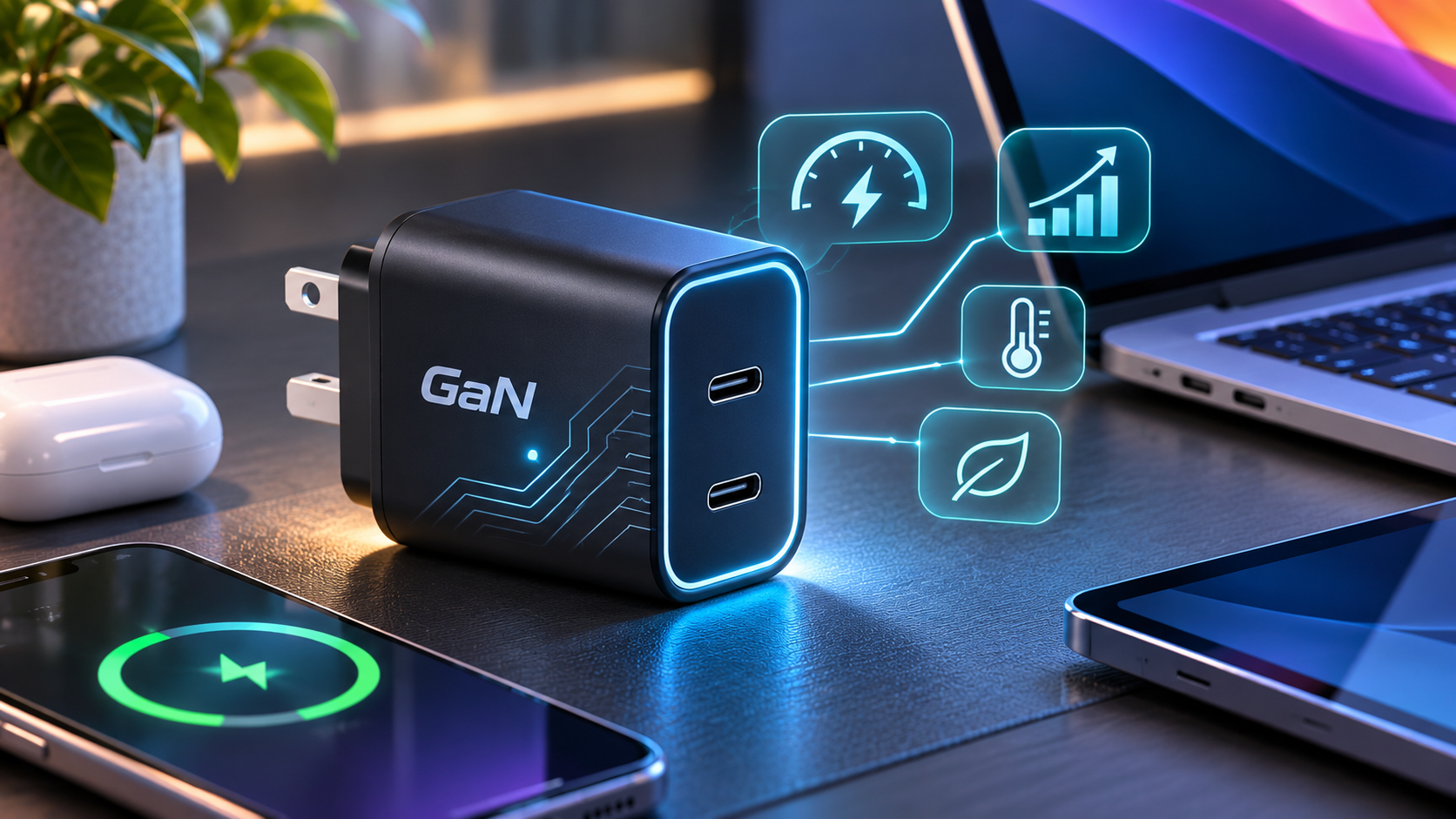
With GaN Charger Efficiency taking center stage, it’s time to explore how this innovative technology is transforming the charging landscape. Imagine a world where your devices charge faster, generate less heat, and contribute to a greener planet. This is the promise of Gallium Nitride (GaN) technology, which is revolutionizing the way we think about chargers, making them not only more efficient but also more sustainable.
This article delves into the fundamental principles of GaN technology, its advantages over traditional silicon chargers, and its real-world applications in consumer electronics. By understanding the key factors influencing charger efficiency, we can appreciate the impact of GaN on device performance and environmental sustainability.
Understanding GaN Technology and Its Impact on Charger Efficiency
The advent of Gallium Nitride (GaN) technology marks a significant shift in the landscape of power electronics, particularly in charger design. Unlike traditional silicon-based chargers, GaN technology leverages the unique properties of gallium nitride, enabling faster and more efficient energy transfer. This advancement not only optimizes charging times but also enhances the overall performance of electronic devices.
GaN technology operates on different principles compared to silicon. Silicon is limited by its thermal and electrical properties, which can lead to energy losses during the conversion process. In contrast, GaN has a higher breakdown voltage and can operate at higher frequencies, which significantly reduces energy loss. This efficiency is crucial in charger design, allowing for smaller, lighter, and more powerful chargers without compromising performance. The benefits of GaN extend beyond mere efficiency; they also include improved thermal management and reduced heat generation during operation.
Advantages of GaN Technology in Charger Design
The implementation of GaN in charger design offers several compelling advantages that contribute to enhanced energy transfer efficiency.
First, GaN chargers can achieve higher power densities. This means that they can deliver more power in a smaller form factor, which is particularly advantageous for portable devices. The compact size allows users to carry chargers that are not only lighter but also capable of charging devices faster. This increased power density is attributed to GaN’s ability to operate at higher frequencies, enabling more efficient switching.
Second, GaN technology minimizes heat generation during the charging process. Traditional silicon chargers often waste energy in the form of heat, whereas GaN devices convert energy more efficiently, reducing thermal losses. This characteristic leads to longer lifespan and reliability of the charger, as excessive heat is a primary factor in component degradation.
Third, the ability of GaN to support high-voltage applications opens up new possibilities for fast charging solutions. For instance, chargers designed with GaN can support higher output voltages, allowing devices to charge more quickly without the risk of overheating.
In summary, the transition to GaN technology in charger design not only improves efficiency but also enhances the user experience by delivering faster, more reliable charging solutions. The impact of GaN on the performance of charging devices is profound, changing the way we interact with and rely on our electronic devices.
Key Factors Influencing GaN Charger Efficiency
The efficiency of Gallium Nitride (GaN) chargers is fundamentally shaped by several key factors, each playing a crucial role in their performance. Understanding these factors can provide insights into why some chargers outperform others, and how design choices can lead to significant differences in energy management and efficiency.
One of the most pivotal factors affecting GaN charger efficiency is thermal management. Due to GaN’s ability to operate at higher frequencies and voltages, it generates more heat compared to traditional silicon-based chargers. Efficient heat dissipation mechanisms, such as heat sinks or thermal pads, are essential to prevent thermal throttling, which can degrade performance. For example, chargers equipped with advanced thermal management systems have been shown to maintain higher efficiency levels during prolonged use compared to those with inadequate cooling solutions.
Thermal Management and Circuit Design
Thermal management not only directly impacts efficiency but also interacts closely with circuit design. A well-designed circuit optimizes the switching characteristics of GaN transistors, which minimizes energy losses during operation. Here are some key design elements that influence performance:
- Switching Frequency: Higher switching frequencies can improve efficiency by reducing the size of passive components, yet they also require precise thermal management to mitigate heat generation.
- PCB Layout: A well-optimized printed circuit board (PCB) layout can enhance thermal performance by allowing better airflow and heat spread, essential for maintaining optimal operating temperatures.
- Component Selection: The choice of capacitors, inductors, and other components can significantly affect the efficiency of the charger. High-quality components that can handle higher frequencies without substantial losses contribute to overall efficiency.
The quality of components used in GaN chargers is crucial for optimizing efficiency. For instance, using low equivalent series resistance (ESR) capacitors can minimize energy losses during charging cycles. High-quality inductors designed for high frequency can also improve efficiency by reducing losses associated with energy storage and transfer. An example of this is the difference in performance noted between chargers that use standard components versus those that integrate premium materials tailored for high-frequency applications.
In summary, factors such as thermal management, circuit design, and component quality work in tandem to influence the efficiency of GaN chargers. Manufacturers that focus on optimizing these aspects are likely to deliver products that not only perform better but also maximize energy savings for consumers.
Real-World Applications of GaN Chargers in Consumer Electronics
The adoption of Gallium Nitride (GaN) chargers in consumer electronics has revolutionized the way we power our devices. These chargers, known for their high efficiency and compact design, are quickly becoming the preferred choice for a variety of everyday electronics, including smartphones and laptops. With their ability to deliver faster charging times and reduced energy consumption, GaN chargers present a modern solution tailored for today’s fast-paced lifestyle.
The integration of GaN technology into consumer electronics enables significant improvements in both energy efficiency and charging speed. Traditional silicon chargers often waste a considerable amount of energy as heat, while GaN chargers operate at a higher efficiency, converting more of the input power into usable energy. This not only leads to faster charging times but also contributes to a reduction in overall energy consumption, making devices more eco-friendly in the long run.
Integration of GaN Chargers in Smartphones and Laptops
The incorporation of GaN chargers into smartphones and laptops demonstrates how this technology enhances user experience through convenience and efficiency. GaN chargers can be found in many of the latest smartphone models, allowing for rapid charging capabilities that can deliver up to 50-100% charge within a short time frame. This rapid charging is particularly beneficial for users who are always on the go.
In laptops, GaN chargers are often smaller and lighter than their traditional counterparts, making them incredibly portable. For example, a standard laptop charger can weigh up to a pound, while a GaN charger can weigh just a few ounces, making it easy to carry alongside the device. This compactness, combined with high performance, allows users to power their laptops quickly while being mindful of space and weight.
Energy Savings and Charging Speed Improvements
The energy savings and charging speed enhancements brought about by GaN technology are significant. Many users have reported charging times reduced by as much as 30-50% compared to traditional chargers. Additionally, GaN chargers maintain lower thermal output, which contributes to longer lifespan for both chargers and devices.
Here is a comparative table showcasing the efficiency of GaN chargers against traditional chargers across different devices:
| Device | Traditional Charger Efficiency (%) | GaN Charger Efficiency (%) | Charging Time (Hours) |
|---|---|---|---|
| Smartphone | 80 | 95 | 0.5 |
| Laptop | 75 | 90 | 1.5 |
| Tablet | 78 | 92 | 1.0 |
“GaN chargers not only speed up the charging process but also represent a sustainable choice due to their higher energy efficiency.”
Environmental Considerations of GaN Charger Efficiency
The rise of Gallium Nitride (GaN) technology in charger design is not only an advancement in efficiency but also a significant step towards sustainability. By utilizing GaN technology, we can achieve lower energy consumption while minimizing the overall environmental footprint of electronic devices.
The environmental benefits of GaN technology stem from its inherent efficiency. GaN chargers operate at higher power levels with reduced energy waste compared to traditional silicon-based chargers. This reduction in energy loss translates directly into less electricity being consumed, leading to a decreased demand for fossil fuels and a lower carbon footprint. Additionally, increased efficiency in charging means that devices generate less heat during operation. This reduced heat generation contributes to longer lifespans for devices and batteries, ultimately resulting in fewer electronic waste materials entering landfills.
Examples of Sustainable Practices with GaN Chargers
Several companies are embracing GaN technology not just for its efficiency, but also as part of a broader commitment to sustainability. Their efforts highlight how the adoption of GaN chargers can lead to significant environmental improvements. Here are notable examples:
- Anker: A leader in charging technology, Anker has integrated GaN technology into its product line, creating chargers that are not only compact but also highly efficient. Their GaN chargers consume less energy, reducing the carbon footprint associated with their use.
- RAVPower: By launching a range of GaN-based chargers, RAVPower has committed to sustainable practices. Their products are designed to be energy-efficient, which contributes to lower energy consumption and extends the life of devices.
- Apple: The tech giant has started incorporating GaN technology in some of its charger offerings. This initiative is part of Apple’s broader environmental goals, aiming to reduce carbon emissions and promote sustainable materials in its products.
- Belkin: Belkin’s range of GaN chargers reflects their commitment to energy efficiency. By reducing energy loss during charging, Belkin plays a role in minimizing the environmental impact of consumer electronics.
Implementing GaN technology in chargers not only enhances user experience through faster charging but also aligns with the global movement towards sustainability. These companies illustrate the potential for GaN chargers to foster environmentally friendly practices while meeting the growing demand for efficient electronic charging solutions.
Future Trends in GaN Charger Development and Market Growth
The landscape of GaN charger technology is rapidly evolving, with numerous advancements on the horizon that promise to redefine charger efficiency and user experience. As the market for GaN chargers expands, understanding these trends becomes crucial for both manufacturers and consumers. This segment will explore anticipated technological improvements, market dynamics, and potential challenges in the GaN charger sector.
Anticipated Advancements in GaN Technology
Future advancements in Gallium Nitride (GaN) technology are expected to enhance charger efficiency dramatically. Innovations such as improved semiconductor materials and designs will play a vital role in this evolution. For instance, the introduction of newer GaN formulations that can operate at higher voltages and frequencies may lead to chargers that are not only smaller but also more efficient.
Technological enhancements may include:
- Higher power density: Future GaN chargers could be capable of delivering more power in a smaller footprint, making them ideal for portable devices.
- Improved thermal management: With better heat dissipation technologies, chargers can maintain efficiency even under high load conditions.
- Integration with smart technologies: GaN chargers could incorporate intelligent features such as adaptive charging, optimizing power delivery based on the device’s requirements.
These advancements are expected to greatly influence consumer preference and market growth.
Market Trends and Consumer Demand
Consumer demand for faster charging solutions is driving the growth of GaN chargers. As smartphones, laptops, and other portable electronics become more power-hungry, the need for efficient and quick charging options is paramount. GaN chargers meet this demand effectively, providing rapid charge times while maintaining a compact design.
Current market trends include:
- Shift towards lightweight and compact chargers: Consumers increasingly favor travel-friendly options that do not compromise on performance.
- Growing adoption of USB-C: The widespread adoption of USB-C across devices has bolstered the market for GaN chargers, as they can efficiently utilize this universal standard.
- Awareness of sustainability: Environmentally conscious consumers are drawn to GaN chargers, which typically consume less energy and produce less heat compared to traditional chargers.
The convergence of these trends is indicative of a robust and expanding marketplace for GaN technology.
Potential Challenges and Opportunities in the GaN Charger Market
While the future looks promising for GaN chargers, several challenges and opportunities must be acknowledged. One significant challenge is the higher manufacturing cost associated with GaN technology compared to traditional silicon-based chargers. This can impact pricing strategies and limit market penetration, particularly in price-sensitive regions.
Despite these challenges, opportunities abound:
- Market education: As awareness of GaN technology’s benefits grows, educating consumers can lead to increased adoption rates.
- Expanding applications: Beyond consumer electronics, GaN chargers are being explored for applications in electric vehicles and renewable energy systems, which may further drive demand.
- Innovation in design: Companies that invest in research and development for GaN technologies can differentiate themselves in a competitive market, leading to increased market share.
Understanding and navigating these challenges and opportunities will be crucial for stakeholders in the GaN charger sector.
Comparing GaN Chargers to Traditional Charging Technologies
The emergence of Gallium Nitride (GaN) chargers has ushered in a new era in charging technology. The efficiency and performance metrics of GaN chargers starkly contrast with those of traditional silicon-based chargers. Understanding these differences is crucial for both manufacturers and consumers as we move towards more efficient power solutions.
Efficiency Metrics
GaN chargers are renowned for their superior efficiency compared to traditional charging technologies. Typically, GaN chargers can achieve efficiency ratings above 90%, while conventional chargers tend to hover around 70-85% efficiency. This disparity has significant implications for energy consumption and thermal management.
- GaN technology allows for lower switching losses, resulting in less wasted energy during the charging process.
- The higher switching frequency of GaN chargers means they can charge devices faster without compromising efficiency.
- GaN chargers maintain performance over a wider range of temperatures, ensuring consistent operation even in challenging environments.
Cost Implications
While the initial investment in GaN charger technology may be higher due to the advanced materials used, the long-term savings can be compelling for both manufacturers and consumers. The overall production costs may decrease as GaN technology becomes more mainstream.
- Manufacturers may face higher initial production costs due to the cost of GaN materials and equipment. However, as technology advances and scales, these costs are expected to drop significantly.
- Consumers benefit from reduced energy bills over time, as GaN chargers are more efficient and minimize energy waste.
- The longer lifespan of GaN chargers can lead to lower replacement costs, making them more economical in the long run.
Advantages in Size and Portability
One of the standout features of GaN chargers is their compact size and lightweight design compared to traditional chargers. This portability is a significant advantage for users on the go.
- GaN chargers can be up to 50% smaller than their silicon counterparts, allowing for more efficient use of space in bags or on desks.
- The lighter weight of GaN chargers enhances their portability, making them ideal for travelers and those who frequently move between locations.
- Despite their smaller size, GaN chargers do not compromise on power output, often offering the same or higher wattage as larger traditional chargers.
“Adopting GaN technology not only enhances charging efficiency but also contributes to a more sustainable future by reducing energy consumption.”
Technical Challenges in GaN Charger Design
The design of Gallium Nitride (GaN) chargers introduces a range of technical challenges that engineers must navigate to achieve high efficiency. These challenges primarily stem from the unique properties of GaN as a semiconductor material, which, while providing superior performance benefits, also demand innovative solutions to optimize system design and functionality. As the technology evolves, understanding these hurdles and addressing them is crucial for developing effective and reliable GaN charger systems.
One of the prominent challenges encountered in GaN charger design is managing thermal performance. GaN devices can operate at higher frequencies and voltages compared to traditional silicon-based devices, leading to increased heat generation. Engineers need to implement advanced thermal management techniques to ensure that the chargers maintain safe operating temperatures. Solutions being explored include enhanced heatsinking, thermal interface materials, and the use of liquid cooling systems in high-power applications.
Power Density and Circuit Design
Achieving a high power density in GaN chargers requires intricate circuit design, combining multiple elements effectively while managing the heat dissipation. This is particularly significant when addressing challenges related to layout and component selection. The following points detail the key considerations for optimizing power density and circuit design:
- Component Layout: The arrangement of components impacts electrical noise and thermal performance. A compact layout can enhance performance but requires careful planning to avoid overheating.
- Switching Frequency: Higher frequencies can improve power density but may lead to increased electromagnetic interference (EMI). Engineers often use filtering techniques to mitigate EMI concerns.
- Efficiency Optimization: Balancing switching loss and conduction loss is vital. Utilizing advanced gate drive techniques can help in achieving an optimal balance for efficiency.
Successful case studies showcase how these challenges have been effectively managed. For instance, the development of the NXP Semiconductors’ GaN-based power adapter demonstrates innovative heat management and compact design. By utilizing a combination of integrated thermal management solutions and optimized circuit layouts, they achieved a power density of over 100 W/in³, setting a benchmark for future developments.
Another example is the use of GaN technology in the Anker PowerPort Atom III, which combines efficient charging with a compact form factor. By employing advanced cooling techniques and high-frequency operation, Anker has successfully addressed thermal challenges while maximizing power output.
“The evolution of GaN technology is paving the way for next-generation chargers that deliver superior efficiency and performance.”
The Role of Industry Standards and Regulations in GaN Charger Efficiency
Industry standards and regulations play a critical role in promoting the development and implementation of efficient Gallium Nitride (GaN) chargers. These standards ensure that manufacturers adhere to best practices that enhance performance, safety, and environmental sustainability. By establishing a framework for testing, design, and performance metrics, standards facilitate competition while encouraging innovation in charger technology.
Adherence to industry regulations impacts charger performance significantly, ensuring devices operate safely and efficiently without compromising consumer safety. Non-compliance can lead to subpar products that may overheat or malfunction, posing risks to users and potentially leading to product recalls or liability issues. In an era where electronic devices are ubiquitous, the importance of reliable and efficient charging solutions cannot be overstated.
Relevant Regulatory Bodies and Their Standards
Understanding the key regulatory bodies that govern charger efficiency can provide insights into the landscape of GaN charger development. These organizations establish critical benchmarks that manufacturers must meet to ensure their products are both effective and safe.
The following list highlights important regulatory bodies and the standards they impose related to charger efficiency:
- International Electrotechnical Commission (IEC) – Sets international standards for electrical and electronic devices, including safety standards for chargers (IEC 61558).
- Institute of Electrical and Electronics Engineers (IEEE) – Develops standards crucial for electronic devices, such as IEEE 802.3 for Power over Ethernet applications.
- Underwriters Laboratories (UL) – Provides certification for the safety of electrical products, with specific standards for power supplies and chargers (UL 62368).
- Federal Communications Commission (FCC) – Regulates communication devices in the U.S., ensuring that chargers do not cause electromagnetic interference (Part 15 of the FCC rules).
- European Committee for Electrotechnical Standardization (CENELEC) – Works on European electrical standards, influencing charger efficiency and safety across the EU.
Industry standards not only govern charger efficiency but also address environmental factors, such as energy consumption and recyclability. Compliance with these standards fosters the creation of sustainable products that meet consumer expectations for performance and environmental responsibility. Manufacturers who align their designs with these standards can gain a competitive edge while ensuring the safety and satisfaction of their customers.
End of Discussion
In conclusion, the advancements in GaN Charger Efficiency are paving the way for smarter and more sustainable charging solutions. As we embrace this cutting-edge technology, we can look forward to significant improvements in charging speed, energy savings, and reduced environmental impact. The future of chargers is bright, and GaN is leading the charge toward a more efficient and eco-friendly world.
Frequently Asked Questions
What is GaN technology?
GaN stands for Gallium Nitride, a semiconductor material that offers better efficiency and performance compared to traditional silicon.
How do GaN chargers improve efficiency?
GaN chargers minimize energy loss during power conversion, resulting in faster charging times and less heat generation.
Are GaN chargers more expensive?
While GaN chargers can have a higher initial cost, their efficiency and longevity often make them cost-effective in the long run.
Can GaN technology be used in all types of chargers?
Yes, GaN technology can be integrated into various chargers, including those for smartphones, laptops, and other consumer electronics.
What are the environmental benefits of GaN chargers?
GaN chargers reduce energy consumption and lower carbon footprints due to their high efficiency and lower heat output.