
A cracked screen, a lost phone, and a hardware failure are different problems, so the right protection depends on which bill we want to avoid. We can choose manufacturer, carrier, third-party, or credit-card protection, but each handles different risks.
The best value is not always the lowest monthly cost. We need to compare coverage, claims, repair choices, and the amount charged for an approved covered claim. That amount is the deductible.
We’ll compare the main options and show how to weigh their terms against the likely repair or replacement bill. A good plan can offer peace of mind, but only when its coverage matches our needs.
For example, a screen repair plan may not help if our main concern is theft. We should compare the premium and claim costs against the repair or replacement bill we could reasonably face.
Key Takeaways
- Match the plan to the phone and the risk we want covered.
- Compare the premium, deductible, and claim limits together.
- Check whether repairs use approved locations and parts.
- Card benefits often require paying the phone bill with that card.
- Compare protection costs with the phone’s likely repair or replacement bill.
9. Best Smartphone Insurance Plans: Which Options Fit Different Needs?
For an iPhone owner who wants Apple-specific repairs, AppleCare+ is the clearest fit; for a Galaxy owner, Samsung Care+ is the direct match. The right phone insurance depends on the device, the covered risk, and how we pay.
Choose protection for the phone we own and the bill we want to avoid, not just the lowest monthly price.
The nine options include manufacturer plans, carrier plans, third-party coverage, and a credit-card benefit. Each has different eligibility rules, repair choices, and claim terms.
Manufacturer plans for Apple and Samsung phones
AppleCare+ is designed for iPhones and offers Apple-specific service options. Samsung Care+ is the matching choice for eligible Galaxy phones.
These plans may suit owners who want repairs tied to the phone’s manufacturer. They are not interchangeable: the exact model and the selected coverage still matter.
Carrier plans for bundled coverage
Verizon Mobile Protect and Verizon Total Equipment Coverage are options for Verizon customers. AT&T device protection and T-Mobile Protection 360 or Standard Device Protection are carrier-based choices.
Carrier coverage may appeal to people who want phone protection billed with their wireless service. We should compare each plan’s covered events and claim costs, not assume all carrier plans work alike.
Third-party and credit-card choices
Progressive’s phone insurance through Worth Ave. Group offers a standalone third-party option. Wells Fargo Autograph cell-phone protection is a card benefit, not a separate policy.
The Wells Fargo benefit depends on paying the monthly phone bill with that card. Other card benefits also have conditions and claim caps, so they may suit eligible cardholders more than people seeking broad standalone insurance.
Before treating any shortlist pick as suitable, check that the exact phone model and the risk we want covered are eligible.
What Does Phone Protection Cover Beyond a Warranty?
A manufacturer warranty generally addresses defects, while phone protection may help with a cracked screen, liquid damage, or another covered mishap. Accidents, mechanical failure, and loss or theft are separate coverage questions.
A phone protection plan may cover accidental damage, mechanical problems, or loss and theft. No single plan should be assumed to cover all three.
Accidental damage and mechanical problems
Common issues include cracked screens, liquid damage, battery or touchscreen failure, and charging-port problems. Some plans cover accidental damage, while others add mechanical or electrical failures.
Loss and theft need separate attention. A plan may cover one, both, or neither, and the contract sets any claim limits and required steps.
Some policies exclude intentional damage. A dropped phone may count as an accident, but deliberately damaging a device is commonly outside the coverage.
Contract language matters more than a plan’s broad label. A plan described as phone protection may still exclude the event that concerns us most.
What a manufacturer warranty usually excludes
A manufacturer warranty usually covers a defect in the phone, subject to its terms. It typically does not cover a cracked screen or liquid spill caused by everyday use.
For example, an eligible hardware defect may receive warranty service, while a fall may require accidental-damage coverage. Progressive’s phone protection is one separate plan option, but its terms still decide which issues qualify.
Match the listed covered events to the specific problem we are most likely to face, rather than assuming the word “protection” covers every loss.
How Should We Compare Phone Protection Plans?
Compare a plan’s covered events, deductible, claim limit, repair method, and eligibility before deciding whether its premium is reasonable. A low price cannot make excluded coverage useful.
We can use the same five checks for manufacturer, carrier, and third-party plans. This keeps us focused on the full contract rather than its monthly charge alone.
- Covered events: Check whether the plan covers damage, defects, loss, theft, or only some of them.
- Out-of-pocket charges: Find the deductible or service fee for each kind of claim.
- Claim limits: Note the number of claims allowed and any maximum claim value.
- Repair or replacement: Learn whether the provider repairs the phone or sends a replacement.
- Eligibility and transfer: Check phone condition, enrollment timing, and rules for upgrades or carrier changes.
A deductible is the out-of-pocket amount charged for an approved covered claim. The charge may differ for screen damage, theft, or a mechanical issue.
Repair details can change the real value of coverage. Contracts may limit repair locations, replacement parts, and additional services, such as tech support.
A plan with a low deductible still may not suit us if it excludes the main risk we face. A higher deductible could be acceptable if the plan covers a costly loss we could not easily pay for.
A plan that excludes the loss we most want covered is the wrong fit, even if its other terms look attractive.
How Do AppleCare+ and Samsung Care+ Compare?
AppleCare+ lists different iPhone service fees by the kind of damage, while Samsung Care+ separates screen, theft-and-loss, and mechanical-breakdown claims. The fee for an approved claim depends on the claim type and device.
Both options connect phone protection to the phone’s manufacturer. We should compare the specific coverage and service charge, not treat either one as a standard manufacturer warranty.
AppleCare+ fees and covered claims
In 2026, AppleCare lists iPhone accidental-damage service fees of $29 for outer display and back glass damage. Cover layer-only damage costs $19.
Inner display damage and other accidental damage each have a $99 service fee. A separate iPhone theft or loss claim costs $149 in 2026.
That difference matters when we compare protection for a cracked screen with protection against a missing phone. The same monthly plan can have different claim costs for each event.
Samsung Care+ repairs, loss, and plan terms
In 2026, Samsung Care+ offers unlimited accidental-damage repairs. Same-day screen repairs may be available for eligible devices in select areas.
With Theft and Loss coverage, a cracked-screen repair costs $0 per claim. With Care+ without that coverage, a cracked-screen repair costs $29 per claim.
Theft-and-loss claims have a $99-$199 deductible, depending on the device. Theft and Loss allows up to three lost, stolen, or unrecoverable claims in any consecutive 12-month period.
Approved mechanical-breakdown claims have no service fee. Fees for other approved claims vary by claim.
Samsung monthly pricing changes by device. Monthly coverage lasts up to three years, or customers can make a one-time payment for two years.
Check the device-specific terms before enrollment, especially the theft deductible and whether same-day repair is available locally.
What Do Verizon and AT&T Device Plans Include?
Verizon’s Mobile Protect combines three services, while AT&T’s offer highlights unlimited claims and $0 screen and back-glass repairs. Verizon Total Equipment Coverage is a different option with stated loss, theft, damage, and malfunction benefits.
Carrier plans can make billing and service easier for some customers. Their names and bundled services do not mean they offer identical phone insurance.
Verizon Mobile Protect includes Wireless Phone Protection, Verizon Extended Warranty, and Mobile Secure in 2026. The three parts combine protection with warranty and security services.
Verizon says Total Equipment Coverage includes loss, theft, damage, and post-warranty malfunctions. It also lists $0-deductible cracked-screen repairs and next-day replacements for lost, stolen, or damaged smartphones.
These are distinct Verizon offerings. We should identify the exact plan name on the account before comparing its coverage or service arrangement.
AT&T advertises unlimited claims for damage, loss, and theft under its device-protection offering. It also advertises unlimited screen and back-glass repairs at $0.
Those broad claim statements do not remove the need to read claim rules. We should check the contract for eligible devices, repair terms, and any limits tied to a particular claim type.
Some AT&T business customers have legacy plans with changes that begin September 1, 2026. The changes apply to Protect Advantage for 4 and Protect Advantage for 41 for Business, excluding plans in New York.
For those legacy plans, the monthly price rises from $45 to $50. The maximum claim value rises from $2,500 to $3,500 per claim.
The updated replacement deductible is non-refundable and ranges from $25 to $299 per claim, depending on the device. The listed amounts are $25, $50, $89, $125, $199, $200, $250, or $299.
These are changes to named legacy business plans, not a general price for every AT&T customer. Old Verizon business-plan prices also should not be treated as current consumer prices.
A business customer on a legacy AT&T plan should check the New York exception and device-specific replacement deductible before relying on the revised terms.
How Do T-Mobile’s Two Protection Plans Differ?
Protection 360 has no limit on accidental-damage or mechanical-and-electrical-failure claims, while Standard Device Protection allows one claim in a rolling 12-month period. Protection 360 has a separate five-claim limit for loss or theft.
The monthly price depends on the device tier. Screen and back-glass repair charges can also vary by tier and phone model.
Protection 360 claim limits and repair fees
Protection 360 monthly prices range from $7 to $26 in 2026, plus tax if applicable. Front-screen repairs cost $0, and eligible back-glass repairs cost $0, $10, or $29 depending on device tier.
Accidental-damage and mechanical-and-electrical-failure claims have no limit. Loss-or-theft claims are capped at five in any rolling 12-month period.
| Tier or plan | Monthly price | Accidental or mechanical claim limit | Screen-repair charge |
|---|---|---|---|
| Protection 360 Tier 1 | $7 monthly | No limit | Front: $0 |
| Protection 360 Tier 2 | $9 monthly | No limit | Front: $0 |
| Protection 360 Tiers 3 and 4 | $13 and $16 monthly | No limit | Front: $0 |
| Tier 5 and BYOD; Tier 6 | $19; $26 monthly | No limit | Front: $0 |
| Standard Device Protection | $5 or $10 monthly | One per rolling 12 months | Device-dependent |
Standard Device Protection costs and claim cap
Standard Device Protection costs $5 or $10 per device each month, plus applicable tax, depending on device tier. It allows one accidental-damage or loss-and-theft claim in any rolling 12-month period.
Protection 360 costs more at some tiers, but it has no cap on accidental-damage or mechanical claims. Compare those terms with the one-claim limit on Standard Device Protection.
Match the tier’s monthly charge and screen fee to the actual device before comparing the two options.
Is Progressive’s Worth Ave. Group Plan a Good Third-Party Option?
Progressive’s Worth Ave. Group option starts at $8 per month for a two-year iPhone plan, but the actual quote depends on the phone and coverage selected. The $8 price is a starting point, not a universal rate.
This standalone phone insurance can suit someone who does not want to rely only on a carrier plan. The contract still needs to match the phone and the risk we want covered.
In 2026, the stated Worth Ave. Group plans have a $75 deductible and allow unlimited claims. Unlimited claims do not mean every problem qualifies for payment.
Pricing varies by phone brand, model, age, and selected coverage amount. A newer phone, older device, or different coverage choice can change the quote.
Before choosing this protection plan, compare its exclusions with manufacturer and carrier options. We should also check how the provider handles repairs and replacements, including where service is available.
A lower premium may come with different coverage or service terms. The deductible matters too, because it adds to the cost when an approved claim occurs.
Compare the $75 deductible and the contract’s covered events with the out-of-pocket cost of the repair we are trying to avoid.
Can a Credit Card Replace Separate Phone Insurance?
A credit-card benefit may cost nothing extra each month, but it is useful only if its billing condition and exclusions fit our needs. Most benefits require paying the monthly phone bill with the eligible card.
Card protection can help eligible cardholders, but it is not the same as standalone insurance. Coverage is secondary to other phone insurance, and common exclusions include lost phones and cosmetic damage.
In 2026, listed deductibles typically range from $25 to $100. Caps and claim periods differ, as the examples below show.
| Card | Per-claim maximum | Deductible | Claim limit or period |
|---|---|---|---|
| Wells Fargo Autograph | $600 | $25 | Two per 12 months |
| Ink Business Preferred | $1,000 | $100 | Three per 12 months |
| American Express Platinum | $800 | $50 | Two approved claims; $1,600 per 12 months |
| Capital One Venture X | $800 or full retail value, whichever is less | $50 | Two per rolling 12 months |
| Chase Freedom Flex | $800 | $50 | Two per 12 months; $1,000 per year |
Wells Fargo Autograph provides up to $600 in cell-phone protection when we pay the monthly bill with the card. Its deductible is $25, with two claims allowed per 12-month period.
Ink Business Preferred offers up to $1,000 per claim, with a $100 deductible and three claims per 12-month period. American Express Platinum allows up to $800 per approved claim and $1,600 per 12-month period.
Capital One Venture X covers up to $800 per approved claim or the phone’s full retail value, whichever is less. Chase Freedom Flex offers up to $800 per claim and $1,000 per year.
These limits do not mean that every card covers theft or loss. Read the benefit terms for the card we hold, since the per-claim cap does not establish which kinds of damage are covered.
What Do Phone Screen Repairs Cost Without Coverage?
An out-of-warranty screen repair ranges from $209 for a Galaxy S26 to $379 for an iPhone 17 Pro Max among these examples. Repair prices depend on the exact phone model.
That range shows why a general phone repair estimate can mislead. A screen price for one phone does not set the cost for another model or type of damage.
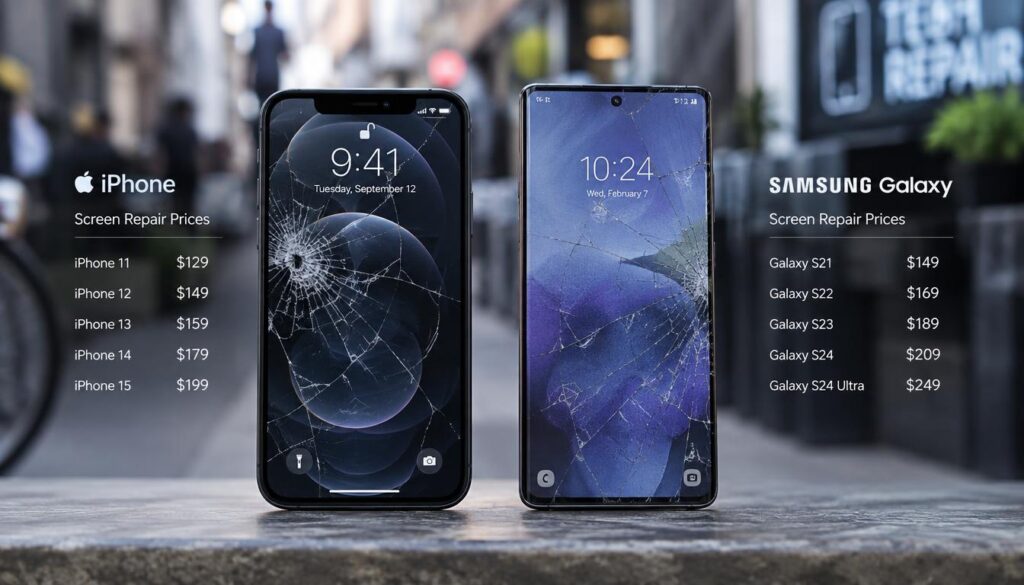
| Phone model | Out-of-warranty screen price | Covered-repair comparison or price note |
|---|---|---|
| iPhone 17 Pro Max | $379 | $29 with AppleCare+ |
| iPhone 17 Pro | $349 | $29 with AppleCare+ |
| iPhone 17 or iPhone 17 Air | $329 | $29 with AppleCare+ |
| Galaxy S26 Ultra | $279 | Before labor and taxes |
| Galaxy S26+ or Galaxy S26 | $229 or $209 | Before labor and taxes |
Apple’s listed out-of-warranty prices for the iPhone 17 family range from $329 to $379. The covered comparison is $29 with AppleCare+ for the listed screen repairs.
Samsung lists the Galaxy S26 Ultra repair at $279, the S26+ at $229, and the S26 at $209. Those prices are before labor charges and taxes.
The figures compare screen repairs, not every kind of damage. A phone with a damaged frame, camera, or other part may need a different repair or replacement estimate.
Check the repair quote for the exact model and damage type before using a screen price to estimate savings.
How Much Does Phone Insurance Cost Each Month?
A rough budgeting range for phone protection is about $5-$20 per device each month, with higher-value phones and broader coverage pushing the price upward. Use that range as a guide, not a quote for a named provider.
The premium can rise with the phone’s value, added theft coverage, or a lower deductible. Covering multiple devices also changes the household’s total monthly cost.
To compare a plan with paying out of pocket, add 12 months of premiums to one deductible. Then compare that total with the repair or replacement bill we would face without coverage.
For example, a plan costing $10 monthly adds $120 in premiums over a year. If the deductible is $100, the first-year comparison is $220 against the uncovered bill.
This is a break-even check, not a promise that we will file a claim. We may pay premiums and have no covered issue, or face a problem the contract excludes.
The number of phones matters when we build a budget. A household paying for several plans should compare the combined yearly premiums with the repair savings each device could realistically receive.
We should not keep paying forever just because coverage once made sense. Reassess when we upgrade and when the remaining repair or replacement exposure falls below the ongoing premium and deductible.
An older phone may cost less to replace than a new model, while its plan premium may continue. The balance can shift as the phone’s value and our savings change.
Recalculate the premium-plus-deductible total whenever we upgrade or change the coverage we need.
When Is Phone Insurance Worth Paying For?
Phone insurance is more likely to be worth paying for when a sudden repair or replacement bill would strain our budget and the contract covers the risk we face. Coverage helps only when it solves a real financial problem.
A newer or costly device can raise the possible bill. Limited emergency savings can also make a covered repair or replacement easier to manage.
Situations where coverage can make sense
Use these four questions to test whether a plan fits our household:
- Could we pay a sudden repair bill without missing other needed expenses?
- Do we rely on the phone for work, school, safety, or daily tasks?
- Do we need coverage for loss or theft, as well as damage?
- Does the contract cover the failure or accident we are most likely to face?
A phone that is costly to replace may justify a plan if its coverage includes the likely event. A busy household with little savings may also value a known claim charge over a large surprise bill.
When paying out of pocket may be better
Setting aside money for repairs can make more sense when we can absorb the bill. Self-funding also avoids paying for coverage that excludes the risk we care about.
Many standard manufacturer warranties last about one year, though terms vary by brand. A warranty can cover defects, but it does not replace a plan for everyday accidents or theft.
Choose coverage only when its covered events and claim terms solve a real financial problem for our household.
What Should We Check Before Enrolling or Filing a Claim?
Before paying for coverage, confirm the exact device is eligible and that the contract includes the event we want covered. Enrollment and transfer rules depend on the provider and the phone’s condition.
Phone protection is sold through a carrier, retailer, manufacturer, or standalone provider. Not every provider accepts an already-owned phone, and some require enrollment soon after purchase.

Confirm eligibility and coverage before enrollment
Check these six contract points before choosing a plan:
- Covered events, including damage, loss, theft, or mechanical failure.
- Claim limits, service charges, and any rules for repeat claims.
- Transferability after a carrier change or phone upgrade.
- Approved repair locations and replacement parts.
- Included support services and any limits on those services.
- Eligibility rules for the phone’s model, age, and current condition.
Existing-phone enrollment depends on the provider and device condition. Upgrade and transfer rules can also differ, so we should not assume coverage follows automatically to another phone or carrier.
Keep the documents needed for a claim
Keep the contract, proof of phone-bill payment when required, and the phone’s model and serial details together. Save claim records, repair estimates, and messages about the case in the same place.
These records can help us show that the phone and claim meet the contract terms. They also make it easier to find the plan’s rules when we need them.
Save the plan terms and any required bill-payment proof where we can retrieve them quickly if a claim is needed.
Conclusion
The right plan is the one that protects against a bill we could not comfortably absorb, without paying for risks we do not need. A low premium alone does not make phone protection a good fit.
We should check our exact device, deductible, exclusions, and claims cap before enrolling. These terms show what we would pay and what the provider may cover.
Our next step is simple: compare the current repair or replacement exposure with the plan’s deductible and exclusions before deciding whether to enroll.