Did you know that over $100 trillion is currently locked in global debt markets? This figure supports the financial system, yet many people struggle to see how these assets generate profit. We define Bond Yield as the annual return you expect when lending capital through fixed-income instruments.
Understanding this concept means examining purchase prices, regular coupon payments, and maturity dates. When market conditions shift, these values change and directly affect your total earnings. It is essential to grasp these mechanics when making informed decisions in a changing economy.
We will explore how the yield curve signals future economic health. We will also examine how a Treasury bond yield sets a benchmark for risk-free returns. These basics help us assess credit risk and compare fixed-income opportunities.
Key Takeaways
- The annual return on debt investments is known as the Bond Yield.
- Prices and interest payments share an inverse relationship with total returns.
- The yield curve provides critical insights into future market expectations.
- A Treasury bond yield often serves as the standard for measuring risk.
- Credit risk assessment is vital when choosing between different fixed-income assets.
Understanding Bond Yield
For fixed-income assets, yield is a useful guide. It gives us one standard way to measure an investment’s possible return and compare securities fairly.
Definition of Bond Yield
At its core, Bond Yield shows the annual return an investor earns from a bond. It includes coupon income, the current market price, and principal repayment at maturity.
Price and return move in opposite directions. A bond above face value is a premium bond and usually has a lower yield. A bond bought below face value is a discount bond and usually offers a higher yield.
How Bond Yield Is Calculated
This measure is easy to calculate when you know its basic parts. Divide the bond’s annual interest payment by its current market price to find the return.
Here is a simple example:
- Assume you purchase a bond with a face value of $100.
- The bond pays a fixed annual coupon of $2.
- By dividing the $2 payment by the $100 price, we arrive at a Bond Yield of 2%.
These calculations help us understand wider market movements. Financial analysts often use the Treasury bond yield as a benchmark for the entire economy. Tracking the Treasury bond yield shows how risk-free rates affect corporate and municipal debt prices.
Types of Bond Yields
Bond returns are not all the same, so investors use several key measures for fixed-income investments. Depending on our goals, we may value immediate income or long-term total returns. These calculations help us make better portfolio decisions.
Current Yield
The current yield shows a bond’s yearly income compared with its market price. It measures immediate return without considering maturity or possible capital gains.
For example, a bond with a $1,000 face value pays $50 in annual interest. If its market price rises to $1,100, the current yield is 4.55%. This measure helps income-focused investors estimate this year’s cash payment.
Yield to Maturity
The yield to maturity gives a fuller view than the previous measure. It shows the total return expected when we hold a bond until its expiration date.
It includes interest payments and any difference between our price and face value at maturity. It considers the time value of money and principal repayment. It is widely considered the most accurate way to compare different bonds.
Yield to Call
Some bonds have a “call” feature that lets the issuer repay the debt before its scheduled maturity date. We use the yield to call to estimate our return if the issuer repays us early.
- Current Yield: Best for immediate income assessment.
- Yield to Maturity: Ideal for long-term holding strategies.
- Yield to Call: Essential for evaluating callable bonds in a changing interest rate environment.
These three measures help us navigate the bond market. Each serves a different purpose and helps match financial data with our goals.
Why Bond Yield Matters
We often view Bond Yield as a key measure of the fixed-income market. It shows the return an investor may earn by holding a debt security over time. Tracking these changes helps us understand how capital moves through the global economy.
Impact on Investment Decisions
When we review our portfolios, we compare possible income with price risk. A higher Bond Yield may attract investors who want steady cash flow, but it can signal credit risks or market volatility. We use this information to decide whether to buy, hold, or sell based on our risk tolerance.
Investors usually review these factors when studying bond returns:
- The stability of the issuer’s financial health.
- The duration of the bond and its sensitivity to rate changes.
- The opportunity cost compared to other asset classes like stocks.
Influence on Market Trends
Beyond personal choices, the yield curve helps show where the financial system may be heading. It compares interest rates with maturity times for debt sharing the same credit quality. Changes in its shape can signal new expectations for economic growth or inflation.
Market participants watch these trends to understand wider financing conditions. For example, stronger bond demand raises prices and lowers yields, which can reduce borrowing costs for businesses and governments. In contrast, a rising yield curve may show expected increases in future interest rates, so we may adjust our strategies.
“The bond market is the most important market in the world because it dictates the cost of capital for everyone.”
Factors Influencing Bond Yields
Three main forces shape bond yields in the current market. These forces interact and affect the returns investors earn from fixed-income holdings. Tracking them helps explain why yields rise or fall over time.
Interest Rates
Central banks help set the direction of the entire bond market. When they change benchmark interest rates, borrowing costs across the economy shift quickly. Asset purchases by central banks can raise bond prices, which lowers the overall yield for new buyers.
Inflation Rates
Inflation can quietly harm fixed-income investments. When prices for goods and services rise, future interest payments lose purchasing power. Investors demand higher yields to offset this loss, pushing bond prices down toward a new market balance.
Credit Ratings
The issuer’s perceived risk determines the premium needed to attract capital. We often see a clear gap between a safe Treasury bond yield and a riskier corporate bond yield. This gap is called the yield spread and compensates investors for added credit and liquidity risk.
To see these risks, consider how market participants view different debt instruments:
- Treasury Bonds: Viewed as the benchmark for low risk, offering a stable Treasury bond yield.
- Corporate Bonds: These carry higher default risk, requiring a higher corporate bond yield to entice investors.
- Yield Spread: This metric widens during periods of economic uncertainty as investors flee to safety.
Ultimately, the yield spread signals the financial system’s health. When the gap between government and private debt narrows, market confidence is often high. A widening spread shows that investors worry more about possible defaults.
Bond Yield vs. Stock Returns
When we review portfolios, we weigh stock market volatility against the predictable nature of bond yields. Stocks can offer significant growth, but their price swings can test an investor’s patience. Bonds usually provide steadier income, but changing interest rates can still move their prices.
Comparing Risk and Reward
To judge an investment’s risk, we often study the yield spread. This measure shows the return gap between debt instruments, such as government bonds and riskier corporate debt. A higher corporate bond yield usually compensates lenders for taking on more credit risk.
Investors must decide whether extra returns justify the possibility of default. Analyzing these spreads helps us understand the market’s current appetite for risk. This comparison helps when understanding the relationship between the stock market and the bond market, so we can balance assets.
Investment Strategy Considerations
Rising interest rates can first reduce the market value of existing bonds. When rates climb, older bonds with lower payouts become less attractive, so their secondary market prices fall. Still, this environment is not entirely negative for long-term holders.
Reinvestment at higher rates can strengthen future fixed-income returns over time. By staying disciplined, we can capture higher payouts when older bonds mature and we move funds into new, higher-yielding securities. This strategy helps us maintain a steady income flow while managing risks from changing economic conditions.
The Role of Bond Yields in the Economy
Bond yields act as a vital signal for the broader financial landscape. These changes show how capital moves through the United States economy. They also reflect investor sentiment and expectations about the future.
Indicators of Economic Health
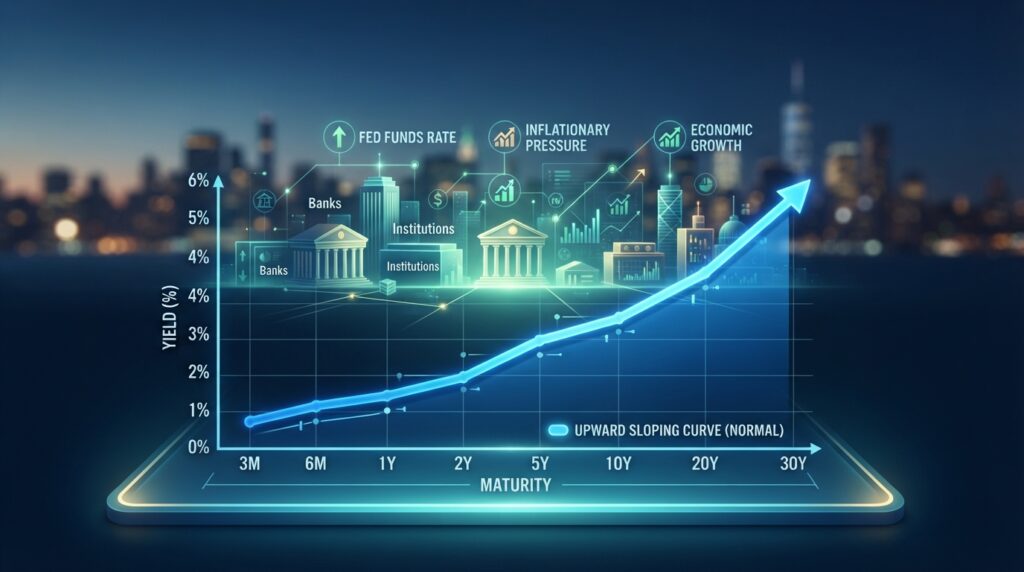
The yield curve is a key tool for predicting economic shifts. It maps debt interest rates across different maturities, comparing short-term and long-term notes. A normal upward slope suggests expected growth and higher future inflation.
Conversely, an inverted curve often concerns analysts. It appears when short-term rates exceed long-term rates, which has often signaled a potential recession. A rising Treasury bond yield at the long end usually shows confidence, while a flattening curve signals uncertainty ahead.
| Curve Shape | Market Expectation | Economic Signal |
|---|---|---|
| Normal | Growth and Inflation | Healthy Expansion |
| Flat | Economic Transition | Neutral Outlook |
| Inverted | Lower Future Rates | Potential Recession |
Monetary Policy Implications
Central bank decisions strongly shape the Treasury bond yield environment. When policymakers change the federal funds rate, they directly affect borrowing costs for banks, businesses, and households. These changes spread through the financial system and alter how we save and spend.
Higher rates raise debt costs, which can slow corporate expansion and consumer spending. By tracking the yield curve, we can predict how these policy changes may affect credit access. These market signals reveal the balance between controlling inflation and supporting sustainable economic growth.
Evaluating Bond Investments
Effective bond investing means looking beyond surface numbers to understand your true potential return. A successful strategy balances income goals with market risks. We analyze key metrics to match choices with long-term financial goals.
Factors to Consider
When assessing a bond purchase, we must look beyond its interest rate. Credit quality shows the issuer’s ability to meet debt obligations. We also examine duration, which measures how interest rate changes affect a bond’s price.
Liquidity and tax effects also guide our decisions. A bond that is hard to sell may not suit a portfolio needing quick cash access. We also check the maturity date to match our time horizon for needing the capital.
Using Bond Yield in Portfolio Planning
We use current yield for a quick view of bond income against its market price. For a fuller total-return view, we use yield to maturity. This metric includes the difference between purchase cost and face value at the term’s end.
Adding the yield curve to planning shows how short-term and long-term interest rates relate. We use bond ladders to manage reinvestment risk. Staggered maturity dates let parts of the portfolio mature at different times, supporting reinvestment at potentially higher rates.
A well-structured portfolio uses Bond Yield as a guide, not its only deciding factor. Together, these tools build a resilient strategy that balances growth and stability. We focus on each asset’s contribution to our overall financial health.
Common Misconceptions About Bond Yield
Many investors believe bond yields work differently from market reality. New investors often confuse simple interest with the bond market’s complex mechanics. Clearing up these myths supports informed financial choices.

Myths vs. Reality
A common myth says the coupon rate equals an investor’s total return. In reality, the coupon is interest paid on the bond’s face value. Buying at a premium or discount can greatly change your actual return.
Another common error is assuming that yield to maturity is guaranteed. This figure assumes you hold the bond until it expires and reinvest all interest payments at the same rate. Selling early or issuer default can make your actual return fall below the original projection.
“The bond market is a place where precision matters, and assuming that a single yield number tells the whole story is a recipe for disappointment.”
Clarifying Key Terms
To navigate the market, distinguish between metrics that describe bond performance. For example, the yield spread measures the yield difference between two bonds and often helps assess credit risk. Understanding these differences helps you avoid traps in financial disclosures.
This table outlines essential terms for evaluating your investments accurately:
| Term | Primary Focus | Key Insight |
|---|---|---|
| Yield to Maturity | Total expected return | Assumes holding until expiration |
| Yield Spread | Risk premium | Compares bonds of different quality |
| Real Yield | Inflation-adjusted | Shows actual purchasing power |
| After-Tax Yield | Net income | Accounts for tax obligations |
Always remember that these metrics are tools, not promises. Analyze a yield spread to gauge market sentiment, or calculate your yield to maturity for long-term planning; context is everything. These distinctions can help protect your capital and improve your portfolio strategy.
Tips for Investors Focusing on Bond Yield
A strong portfolio needs a careful plan for fixed-income assets. Look beyond simple numbers to understand the health of your holdings.
Deep Dive Into Market Data
Successful investors research carefully before committing capital. Evaluate the Bond Yield by checking maturity dates, duration, and tax effects. Reviewing issuer credit quality can help protect your principal from sudden market shifts.
Selecting Assets With Precision
The current yield shows your immediate income potential. Balance it against the risks of corporate bond yield, since higher payouts often signal a greater chance of default. A high return may not fit your long-term goals, so weigh each choice against your risk tolerance and liquidity needs.