Did you know the United States produces over 25 trillion dollars in goods and services every year? This huge number shows the massive scale of our national output. It’s the core of our financial system.
To understand these huge numbers, we use a key metric called Gross Domestic Product. Knowing the GDP meaning is crucial for seeing how our country does globally.
This measurement is like a main scorecard for our economic health. When it goes up, it usually means businesses are doing well and jobs are easier to find.
By watching this data, we get a better idea of how our personal finances relate to bigger trends. In short, GDP is a key guide for navigating the complex American economy today.
Key Takeaways
- The national output of the United States exceeds 25 trillion dollars annually.
- This metric functions as a comprehensive scorecard for overall economic performance.
- Tracking these figures helps us understand the health of the labor market.
- Individual financial stability is often linked to these broader national trends.
- Learning these concepts allows us to make more informed decisions about our personal finances.
What is GDP?
We often hear about the economy growing or shrinking. But what exactly are we measuring when we look at GDP? It’s like a scorecard for the financial health of the United States.
A Simple Definition
The GDP definition is the total value of all goods, services, and structures made in a country in a certain time. It shows how much economic activity is happening. This includes everything from the food we eat to new buildings.
When we calculate this, we only count final goods. This avoids counting the same thing twice. For example, steel used to make a car is only counted once, as the finished car. This makes sure we get a true picture of the economy’s value.
Components of GDP
To understand Gross Domestic Product, we look at four main spending areas. These areas show how money moves through our economy:
- Personal Consumption Expenditures: This is all the money spent by households on things like food, healthcare, and rent.
- Gross Private Domestic Investment: This includes business spending on things like equipment, software, and new homes.
- Government Consumption and Investment: This is all the money spent by governments on public services and building projects.
- Net Exports: This is the difference between what we export and what we import, showing our trade balance.
By looking at these four areas, we can see where the economy is growing. GDP is a key tool for those who make economic decisions and investors to understand the health of the Gross Domestic Product of the United States.
The Importance of GDP for the Economy
Gross Domestic Product is key to understanding the health of the United States economy. It measures the total value of goods and services produced. This gives us a clear view of our nation’s financial health. Knowing the GDP importance helps us see how our country works on a big scale.
Economic Health Indicator
This metric is seen as the best way to check our national prosperity. When the Gross Domestic Product goes up, it means businesses are doing well and people are spending more. On the other hand, a drop can signal trouble ahead.
This data lets us compare today’s economy to the past. It tells us if the economy is growing too fast or too slow. Reliable data is key for making long-term financial plans.
Influencing Government Policy
Government officials use these numbers to make smart money and tax plans. By watching GDP changes, they can adjust rates or taxes to control spending. This helps keep the economy stable.
If growth slows down, the government might use special programs to boost jobs and spending. If growth is too fast, they might make things tighter to stop inflation. This balance helps keep our economy steady.
| Indicator | Primary Purpose | Policy Impact |
|---|---|---|
| GDP | Measure total output | Fiscal/Monetary adjustment |
| Inflation Rate | Track price changes | Interest rate control |
| Unemployment | Monitor labor market | Job creation programs |
How GDP is Calculated
Understanding Gross Domestic Product is key to knowing a nation’s economic health. Economists use three main ways to figure out the total value of goods and services made in our country. Each method gives a different view, but they all aim for the same goal.
The Production Approach
The production approach looks at the total output of all sectors in the economy. It adds up the value added by each industry, like manufacturing and services. This way, we don’t count the same goods twice.
The Income Approach
The income approach adds up all the earnings from producing goods and services. This includes wages, rental income, interest, and corporate profits. It shows how wealth is spread out among people.
The Expenditure Approach
The expenditure approach is the most common way to calculate GDP. It looks at the total spending on final goods and services. The GDP formula is: GDP = C + I + G + (X – M).
In this formula, “C” is personal spending, “I” is private investment, and “G” is government spending. “(X – M)” is net exports, found by subtracting imports from exports. This method gives a clear picture of our Gross Domestic Product by showing where money is spent.
Real GDP vs. Nominal GDP
To understand how the Gross Domestic Product changes, we must look beyond prices. There are two main ways to report economic data. Knowing these methods is key for tracking the American economy.
Understanding the Difference
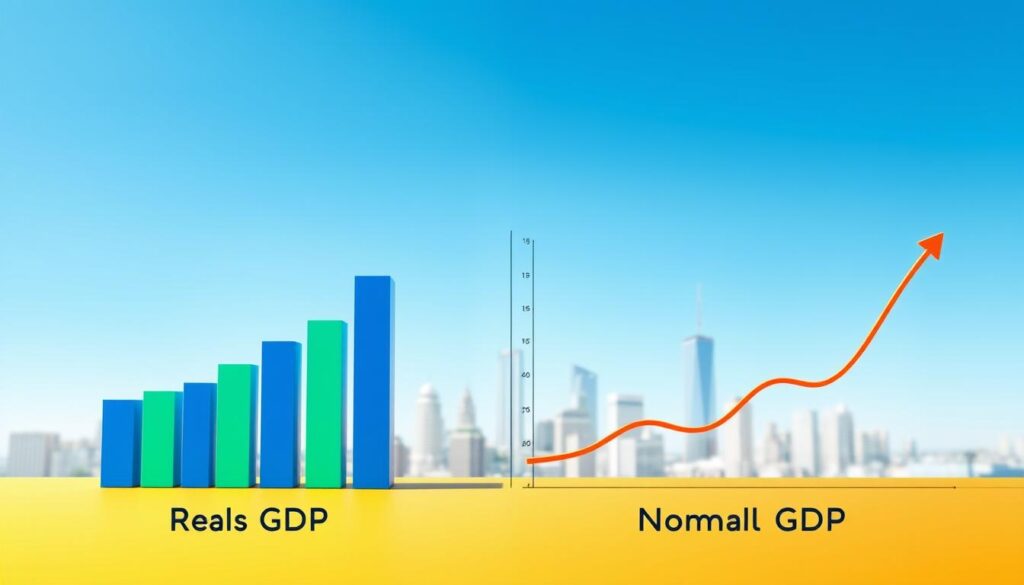
Nominal GDP shows the total value of goods and services at today’s prices. It can be affected by inflation. If prices go up, nominal GDP might show growth even if production doesn’t change.
Real GDP, on the other hand, adjusts for inflation. It uses a base year to set prices. This way, we can see if the economy is really producing more, not just charging more.
When to Use Real vs. Nominal
We use nominal figures to see the economy’s size in today’s dollars. It’s good for short-term views or debt-to-GDP ratios. But for long-term trends or comparing decades, real metrics are better.
The table below shows the main differences between these two important indicators:
| Feature | Nominal GDP | Real GDP |
|---|---|---|
| Price Basis | Current Market Prices | Constant Base Year Prices |
| Inflation Impact | Includes Inflation | Excludes Inflation |
| Primary Use | Current Economic Size | Actual Growth Tracking |
| Accuracy | Can be misleading | More precise for growth |
By focusing on real Gross Domestic Product, we get a clearer view of our nation’s output. This helps policymakers and investors make informed decisions, based on real productivity, not just prices.
GDP Per Capita: A Deeper Look
Looking at a country’s wealth means checking how much each person earns on average. Total Gross Domestic Product shows how a nation grows, but it doesn’t show how people live day-to-day. By looking at smaller numbers, we can see how money affects people’s lives.
How It’s Calculated
To figure this out, we divide a nation’s real GDP by its population. This easy math lets us see how much money each person gets. It’s a standardized way to compare countries of all sizes.
This method helps us ignore the size of a country’s population. A big country might have less money per person than a smaller one with a productive workforce. This is key for economists to see how productivity changes over time.
Implications for Standard of Living
We often use GDP per capita to guess a country’s standard of living. A higher number means more money for public services and personal spending. It gives us a useful snapshot of what people have to spend.
But, we must be careful with these numbers. This figure doesn’t show how money is spread out among people. A high GDP per capita doesn’t mean everyone is rich. It doesn’t show all the social and economic gaps.
The Role of GDP in Global Comparisons
We often look at national output to understand how countries stack up against one another on the world stage. By using a standardized metric, we can translate complex economic data into a universal language. This helps us evaluate the relative prosperity of different nations.
Comparing the US with Other Economies
When we evaluate the United States against other major powers, we must look at more than just raw numbers. While Gross Domestic Product provides a baseline, it does not always tell the full story of what a dollar can buy in different regions.
To solve this, economists use Purchasing Power Parity (PPP). This adjustment accounts for the significant differences in the cost of living between countries. By normalizing these costs, we gain a much clearer picture of the actual standard of living and economic output across borders.
The Impact on Trade and Investment
These comparative metrics serve as a vital compass for international trade strategies. When we analyze the GDP of potential trading partners, we can better predict market demand and identify stable environments for long-term growth.
Investors also rely heavily on these figures to decide where to allocate capital. A nation with a growing Gross Domestic Product often signals a healthy, expanding market that is ripe for foreign investment. By tracking these trends, we can make informed decisions that support both domestic interests and global economic stability.
Limitations of GDP as an Economic Measure
GDP is a strong tool for tracking market activity. But it’s not perfect for measuring society’s well-being. It often misses the important details of our daily lives.
By only looking at market transactions, we miss the big picture. This picture includes what truly makes a society healthy and thriving.
What GDP Doesn’t Capture
The main problem with Gross Domestic Product is its narrow focus. It doesn’t value human and environmental worth. It ignores parts of our economy that don’t involve money.
Here are some things GDP misses:
- Unpaid household labor: Important work like caregiving and cleaning is not counted.
- Environmental degradation: The loss of natural resources and pollution costs are ignored.
- Informal economic activity: Bartering and volunteer work improve our lives but are unseen by standard metrics.
Ignoring these aspects can lead to poor policy decisions. Economic growth that harms the environment or social stability may not be good for us in the long run.
Alternatives to GDP
Many experts and policymakers seek better measures. They want to see the full picture of progress. These alternatives aim to add social and environmental health to the mix.
Some key alternatives are:
- Genuine Progress Indicator (GPI): This adjusts for income inequality and subtracts environmental damage costs.
- Human Development Index (HDI): It looks at life expectancy, education, and income to measure human potential.
- Gross National Happiness (GNH): This focuses on happiness and cultural preservation, along with economic output.
Using these different metrics helps us understand our nation better. While Gross Domestic Product is still important, these alternatives help us aim for a better future. A future that is sustainable and fair for all.
Recent Trends in US GDP Growth
The American economy has shown resilience and recovery. By looking at the data, we see how the nation got past the big challenges of 2020. It then went beyond its previous levels of output.
Historical Context
To understand our current economic state, we need to look at the past. The Gross Domestic Product bounced back as businesses reopened and people started spending more.
In 2021, the economy grew a lot, with a GDP growth rate of 6.1%. Then, it stabilized, with a growth rate of 2.5% in 2022. By 2023, the economy kept growing, with a rate of 2.9%.
Current and Future Projections
These numbers show how our economy goes through ups and downs. The fast growth after the pandemic was followed by a more steady pace for the GDP.
Now, we watch these trends to see if the Gross Domestic Product keeps moving forward. Keeping a steady GDP growth rate is key for those in charge and investors. As we go on, being able to adjust to new market situations will be crucial for lasting stability and more GDP growth.
The Relationship Between GDP and Employment
The health of the labor market is closely tied to the nation’s total output. When the economy grows, businesses feel more confident. This confidence leads to more jobs for American workers.
How GDP Affects Job Creation
When the Gross Domestic Product goes up, it means businesses are making more. They need more staff to handle production, logistics, and customer service. This growth is a key reason for job creation in the U.S.
As companies grow, they invest in new technology and people. This investment boosts the GDP and creates lasting job opportunities. A strong economy also leads to better jobs, with more benefits and stability.
Unemployment Rates and GDP Growth
On the other hand, economic downturns often lead to higher unemployment. When the Gross Domestic Product falls, companies might cut costs by reducing output. This can mean fewer jobs or even layoffs.
Slow GDP growth also limits wage increases. With less demand for labor, workers have less power to ask for higher pay. Keeping the GDP growing is crucial for low unemployment and fair wages.
Conclusion: Understanding GDP’s Broader Implications
We see the national economy as a complex machine that needs constant watching to stay stable. Gross Domestic Product is our main scorecard, but it’s just one part of a bigger picture.
Using just one number can hide how people really live in the United States. We need to look at gross domestic product and its role in our economy to see how growth affects us. This data shows us where we do well and where we need to improve for our communities.
Real prosperity is more than just numbers going up. We should think about environmental quality, income fairness, and social happiness too. Mixing these with GDP gives us a better view of our progress together.
We encourage you to keep up with these changing economic trends. By digging into the details of the data, we can push for policies that help everyone grow in a sustainable and fair way.